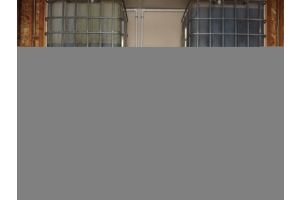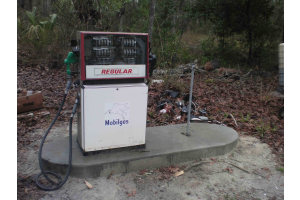
That's a glimpse into my local veggie co-op. To some, the term "co-op" inaccurately describes a group where one person does all the work. Fortunately with our group, the term co-op accurately describes how we function. Not everyone does the exact same amount of work, but no one is working too hard and there has always been oil ready. Someone always knows when to pitch in and help when there is work to do. A responsibility many of us don't learn until much later in life.
We keep a running tab of how much oil each individual brings in, and that is how much they can take out. There are 3 of us. Until someone has a significant interest in joining(and a potential contribution to offer), we offer people clean oil in trade for dirty. We take 50% of the oil that we clean. This 50% arragement has been a mutually advantageous system I've used for years.
The process is simple. We collect our oil from local restaurants in the 5 gallon cubies. We then settle the oil it some old propane tanks, that we paid too much for($250 each). We are careful not to dump the "dreggs" in there. I find it best to have a multi-stage oil cleaning operation. When you are careful not to dump crud into your fine cleaning equipment, you get a much better final product and less hassle.
The local Hazmat center takes our dreggs. It doesn't make good fertilizer and will kill plants. I would infer that the oil suffocates the leaves and roots.
After a couple weeks of settling, we pump it with the Raw Power Oil Pump, hands down the pump for WVO. I'm biased, but really...customers have told us that this pump has "changed their lives". So we use the pump to move oil inside the building to a 275 gallon tote, elevating it for cleaning with the Raw Power Centrifuge. So, we'll fill that tote up with however much settled oil we have at the time.
From the top tote, inside the building, the oil flows into the centrifuge, then out to the bottom port on the lower tote. To begin the process, one person will stop in and open the valve on the top tote and power up the centrifuge and heater. Then someone will return hours later to shut down the centrifuge/heater. We typically do 5 hour runs and we clean the oil at a rate of 15 GPH, so that gives us 75 gallons of clean oil.
You may be wondering why the centrifuge is plumbed into the bottom port(yes, it will work this way if properly vented, fluid dynamics continue to amaze me). This is done for ease and it is an extra safeguard. It is a process called "upflow settling" that I learned about from one of those 12am forages through a forum. The new oil comes in at the bottom. Then the absolute cleanest oil rises to the top. I'm confident the centrifuge removes everything, but I error on the side of caution in case the flow is accidentally too high. With many hands, there is room for error. Also, single tank vehicles can't burn the creamy oil, which will sit on the bottom of the tote once cleaned by the centrifuge.
 Settled Oil Left...Centrifuged Oil Right
For fill-ups, we start with a loosely-stuck hose into the top of the lower tote. I have an old, war-torn pump I use for this light duty job. The fill-up pump needs a pressure bypass, so we don't blow off our hoses when the filling nozzle is restricted. You can use the Raw Power Pumps for this, but you need to cut the power when you stop the flow as our current models don't have a pressure bypass(but one is coming soon!)
That's the long and the short of it. I know you have questions...hit me up on the comments below or the forum.

-Jason Jelonek