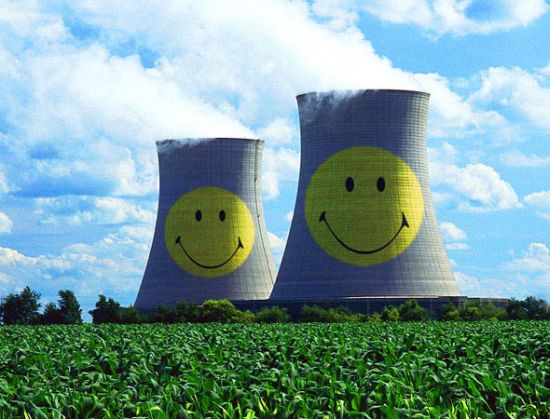

With radiation once again poisoning Japan, this time from nuclear power plants, the news is abuzz with facts, figures and questions about Nuclear Power. It's not hard to spot out the "white knights" from the nuclear industry, flown in special to explain how safe nuclear power is and how much we need it. I agree with one point, in that right now, we need it. There are 104 Nuclear power reactors in the US. They are firmly planted in 31 states. If you live in the Eco-friendly state of Vermont, your state's electricity is primarily powered by Nuclear Reactions...72%(So that Ben and Jerry's we've all indulged in is likely made from Nuclear Power). Over 20% of US electric power comes from Nukes.
The claim that "nuclear is still safe" on the other hand, rings the B.S alarm bells much like when my 4 year old tries to cover up a simple lie. For starters, Nuclear power produces a toxic poison that lasts forever as far as we are concerned. How is it OK to produce something like this? We still haven't found a safe and secure way to "dispose" of it. No one wants it in your back yard, right Nevada? We made it, now we have to live with the deadly waste. C'mon, there is really no sure way to store this. We can only guess that the poison will not break free from earthquakes, volcanoes or sabotage.
Secondly, Japan's saga reminds those who have forgotten that the reactors themselves are prone to failure from operator error, catastrophic acts of nature, or again sabotage. Is this something we are willing to live with? The occasional poisoning of regions due to nuclear meltdowns? Apparently so, as communities all over the world continue to build and become dependent on Nuclear Power.

- Source: DOE
Contrast the 20% of electricity in the US coming from Nukes with 10% coming from renewable, and you will see that we are missing an opportunity here. Most of the renewable energy comes from hydro-electric power from damming our rivers, %66. Also, burning wood is considered renewable which accounts for 9% of the renewable. So 74% of "renewable" energy comes from burning trees and "damning" rivers. Think solar is big? That only accounts for .2% of the renewable energy or %.02 of total US electricity generation. Say, isn't there's a lot of free energy coming from that big yellow orb in the sky? Think we need more renewables, ones other than wood and hydro? I do. Why don't we have more? Here are two excuses straight from the DOE:
- Renewable Energy Technologies Are Capital-Intensive: Renewable energy power plants are generally more expensive to build and to operate than coal and natural gas plants. Recently, however, some wind-generating plants have proven to be economically feasible in areas with good wind resources, compared with other conventional technologies, when coupled with the Renewable Electricity Production Tax Credit (described below).
- Renewable Resources Are Often Geographically Remote: The best renewable resources are often available only in remote areas, so building transmission lines to deliver power to large metropolitan areas is expensive.
Let's look at solar. You can't tell me that the millions of suburban rooftops are remote. It's possible to be more capital intensive than fossil fuels on a large scale, but brought down to a micro-scale it is very doable. For many homeowners it can cost less than that new additional, or upgraded kitchen, especially with tax credits. Yes DOE, your top down model of problem solving clasps on to the status quo, fossil fuels are cheaper up front. However, it is becoming clear that buy now, pay later is economic and environmental death sentence.
What about a bottom-up model? A model where communities and households working individually and collectively to produce energy? Hey DOE, you conglomeration of ex-energy company execs. Has the idea been given proper consideration around your oil-stained boardroom tables yet? I know guys and gals, there's no clear cut way for large and influential companies to make a killing off localized energy production, that's why we don't rely more on renewable energy. I'll bet my WVO Mercedes on it.
Check out this renewable presentation from the DOE:
http://www.eia.doe.gov/energy_in_brief/slideshows/renewable_energy.html
~Jason Jelonek